Man of Many Musical Faces, Many Musical Accomplishments Stays Humble and True
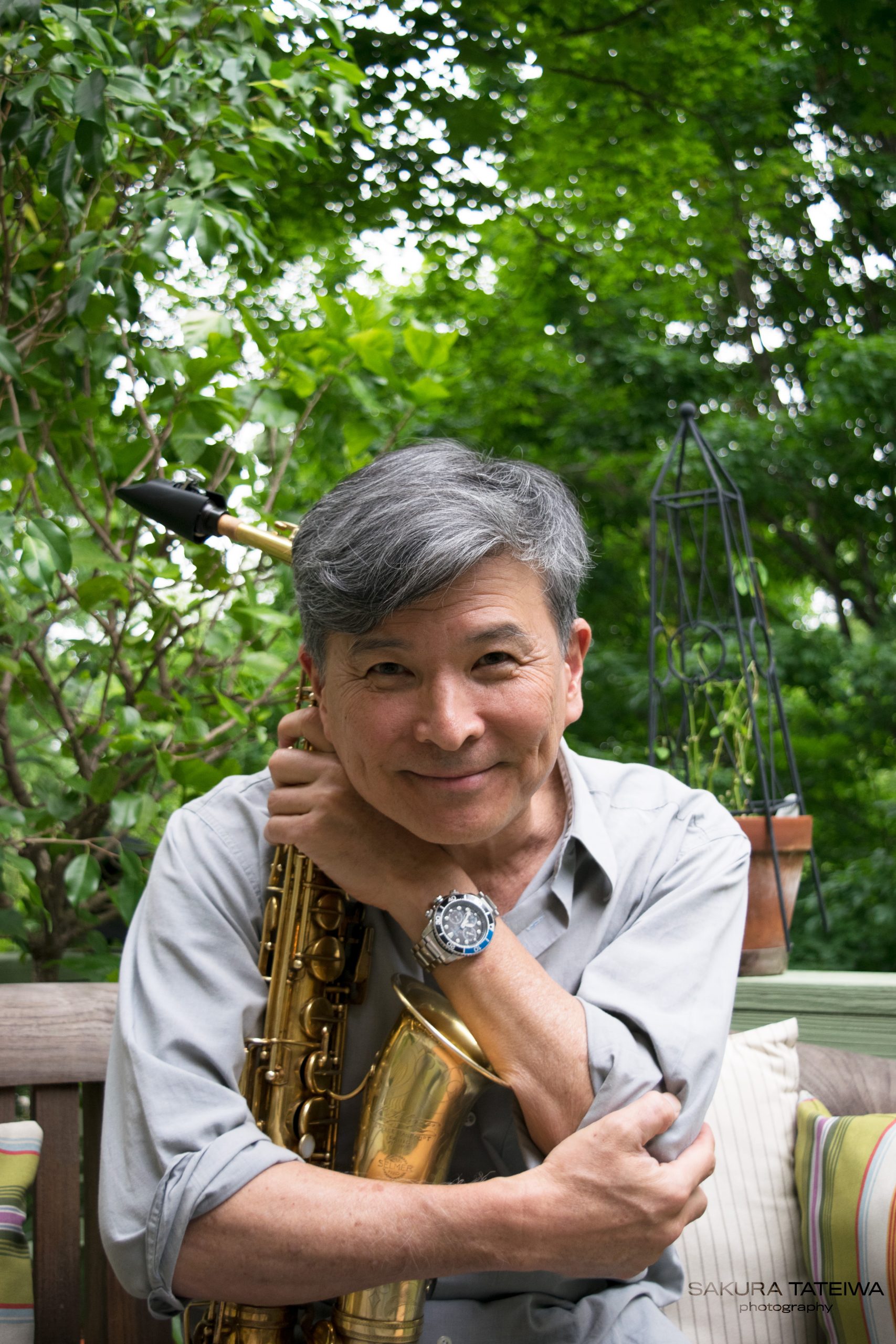
Photos c/o Allen Won
Oh, the stories Allen Won could tell of life as a working musician in pre-Giuliani 1980s New York! It’d make your hair stand on end!
The woodwind doubler did what very few dared. He ventured from the laid back, sunny climes of paradise straight into the nitty-gritty Big Apple to study at Mannes College of Music before eventually landing in a pot of jam called “Hair,” that smash Broadway musical, serving as composer/pianist Galt MacDermot’s saxophone soloist for 35 years.
From there, it kept getting better.
Won found himself in the company of some heavy-hitting giants, heroes, who taught him to always play fully with every fiber of his being and take in the music reverently, with gratitude for the moments that connect the artist with the audience.
That open-hearted, fresh-faced local boy who gratefully made fast friends in Honolulu’s Washington Intermediate School Band, soon began rubbing shoulders with the big names of jazz, blues, pop, and every genre in between: sitting in with Grammy-Award-winning roots-rock drummer Levon Helm and his Band at their weekly Midnight Ramble session up in Woodstock, stints with the New York Philharmonic and Metropolitan Opera, jamming with and accompanying Little Feat, Regina Carter, and a host of legends, including Louis Bellson, Jimmy Cobb, and Jackson Browne.
And yes, that’s Won doing his thing in the cast recording of “Hair,” as well as the score for Steven Spielberg’s 2021 “West Side Story.”
In an exclusive interview, Allen Won touches on the blessings of gigging in the heart of the big, scary, gritty city, as well as what brought him there — and back.
Where are you now? I heard you’re in Hawai’i for good. What made you come back home?
I moved back to Hawai’i on January 3, 2020. The purpose was to be more involved with my aging parents’ care. My mom was turning 90 and my dad was 85 at that point. I’ve never considered myself to have good time, but this was perfect, as we all know now what happened in March of 2020. They both have dementia, and I came to realize how far along they both were.
What’s the first thing you ate?
I don’t really remember what I first ate coming home, but I’m sure it was probably poke and a bag of poi [laughs]! I’m still very local that way.
What’s the difference between living on the Mainland’s East Coast and in the islands?
As I told my son when I visited in 2022, I really dislike the cold now and it was a balmy 50 degrees in December! So moving back to Hawai’i has been great for that. Also access to real Hawaiian food and great Asian cuisine in general, but I have to admit, I do miss a good spaghetti and meatballs…
As far as the difference with Hawai’i and living on the East Coast, there are a lot of examples. Weather obviously, people are generally nicer here and less rushed, but what I do miss is the phenomenal pool of great musicians. It’s not that the musicians here aren’t musical, I think there may be more musical players here, but what I miss is the fact that the players out East just have this hunger and drive in their playing. Also, you don’t have to discuss much about how to approach a certain type of music, it’s just more intuitive back East. I guess that [comes from] playing all kinds of genres all the time.
What does an average day, week, look like? What’s going on with your music, where do you gig, any regular spots?
My musical life is tied to the Royal Hawaiian Band, as I am its full-time tenor sax player. A position came up and I figured, why not? So I took the audition and interview and they chose the old man. I was 65 when I was hired and I feel very honored and fortunate to still be of use to an organization like this.
We work five days a week, sometimes more. Schools, Ala Moana Mall, Iolani Palace, and the Kapiolani Bandstand are regular venues for the band. It’s now made up of professional musicians all having to prove a degree in music, along with a resume of professional work. So, the band plays at a different level than when I first started subbing in the band when I was out of high school.
Along with the Royal Hawaiian Band jobs, I play quite frequently with drummer Noel Okimoto. He’s had a regular end-of-the-month gig at the local union Studio 909 going on four years now. It’s extremely well-attended and if you don’t get there early, you risk not having parking or a seat! Yay for live jazz!
You kind of found yourself in a pot of gold, when you wound up switching from a music education major at UH to undergrad/master’s degrees at the prestigious Mannes College of Music in New York City. Meaning, a world of Broadway musicals, as well as performing with the New York Philharmonic and Metropolitan Opera. Then, there’s Levon Helm’s The Band and their weekly Midnight Ramble jam sessions in Woodstock.
[This one’s from my husband and your jazz pianist friend Ed Weber:] What happened there with those pivotal inflection points, and how did they lead you to become the well-rounded musician’s musician you are today, how did these diverse experiences shape you as a player and a person?
To try and answer Ed’s question, playing with great players makes you better, even when they bury you onstage. All of the things you hear about how playing with players better than you helps you is true.
I not only performed regularly with Galt MacDermot [“Hair”], but also with drummer Bernard Purdie. Hearing a drummer like that every week for 20 years has a profound effect on one’s approach to music. Levon Helm was probably the nicest band leader I ever worked for. From the first moment I entered his house, the Barn in Woodstock, NY, he greeted me warmly and was always welcoming. I don’t know Levon from his early days with The Band, but I can say when I met and performed with him and his band, he was generous with his time and money and, more importantly, made you feel noticed. He openly acknowledged everyone in his band and told us on a regular basis how much he personally appreciated us being there.
With all these experiences, and trust me, there was a lot that wasn’t so great, I learned that you can be a real human being and still be admired for your playing. Galt, Levon, the guys in Los Lobos were great examples for me.
I feel that when you are fortunate enough to play in these upper-echelon gigs, it also changes your approach and attitude. Players are more relaxed, show up early, and are prepared. Also, stage attitudes are much more noticeable. What they wear, how they keep themselves, and how they express themselves through their music are oftentimes, breathtaking. They up the musical expression so much, it’s like that saying, Go big or go home. You learn that, to be vulnerable and allow the listener in, is really the key to having your audience be more appreciative. You’ve taken the move to include them in on the creative process and the audience responds in ways that, if you didn’t, would be less satisfying for all involved.
What sparked that creativity to go into music in the first place, and why did you change from music education to music living?
Well, this wasn’t planned by me. When I started band in the 7th grade at Washington Intermediate School, I had no friends. It’s a rather long and boring story, but just to say, I came to Washington not knowing anyone, so I was an outsider.
Band was an opportunity to meet new people, which freaked me out, ‘cause I didn’t want to be judged, but it turned into something else. Almost immediately, I was accepted by my band mates and they asked me to hang with them. I was thrilled.
My 8th grade year was a pivotal time, as my best friend asked me to audition for the 9th grade advanced band, so we could play Christmas music and go on a band trip [laughs]! Well, I auditioned, and the band director said if I took private lessons, he would allow me to join the advanced band. My dad said we could afford the lessons, which were $2.50 a half an hour, and I started to improve, I guess. I still had no idea what it meant to really play; I was just happy to be part of a bunch of fun people.
It was later in the year, because I continued to take lessons, that my teacher told me one day, “You could be better than all those clowns out in the band room.” I looked at him as though he went nuts. But that was enough to get me to practice and that was that.
All through junior high, high school, and even at the University of Hawai’i, I wanted to play well and kept practicing. Going into education was what my parents wanted, but I just wanted to play and I knew that I wasn’t organized enough to be a band director. So, when the opportunity came to go and study in New York City, I jumped at it. Although, truthfully, it scared the sh*t out of me. I knew I wasn’t good enough to survive in New York, but I wanted to be there maybe because I’m stupid. I took a beating every day and with every gig, because I always would find players that would just play me into the ground. Why I just didn’t give up, I don’t know.
My path was not easy in New York, but I persisted. I did what I could to survive as a player. Weddings, parties, independent jobs with experimental groups, and teaching, of course. Everything taught me something I needed to know. Like teaching, I soon realized that not everyone takes music as seriously as I do, so I needed to lighten up on my high school and junior high school students. The college ones I blasted, because that’s how I was taught and I truly wanted them to be better than me, because I knew how hard the biz was.
Even with all that I knew and have been through, I still couldn’t break that glass ceiling. I would not change anything, because I’m the way I am, because of all those experiences.
Do you have any regrets? What would you do differently, if you could go into a time machine and relive your life?
I have to be truthful in that I never wanted to tour with a big band. I had an experience doing what we called a runout. That’s when you leave in the morning, drive somewhere, do the gig, and return home the same day. As soon as I got on the bus with my uniform and horn, the rest of the guys showed up, but in addition to what I had brought, almost everyone had an ice chest. Soon after the bus started rolling, drinks and bags of pills were being distributed to whomever wanted to partake. It was sheer madness and pandemonium for about two hours, then silence for about eight.
Practically the whole band was drunk and high. I thought, if this was the road, I wouldn’t last one day. When we got back to the city, I vowed I’d never go on the road with a big band. I find it funny now. I did do runouts and even short tours with Levon’s band and a couple of smaller bands. I really enjoyed it. That would be my only regret looking back, I would have learned a lot hanging with the fellas. Oh well…
Do you have any advice for young, up-and-coming musicians wanting to take the same path, or pave their own?
Advice for young players? Practice while you can and develop your own sound and do what you can to develop self-discipline, like meditation and regular exercise. I think playing occurs in the head anyway. A person will figure out if music is their path. Oh, and don’t get married too young, because, to be a good musician requires one to be very selfish.
By the way, I don’t think I chose music, music chose me…
Music is your life. Classical music was your destiny. But you play all styles equally well, to hear your colleagues tell it. Where does your soul gravitate? Any particular genre, mood, vibe…live onstage with your friends, sharing something original from a new album, in the recording studio laying down tracks, backing a headliner hero on a world tour, a spontaneous late-night jam session at a low-key club, with just a few leftover guests in the audience, orchestra pit on the first day of a new Broadway musical?
In preference for musical styles, I’m fortunate that I love almost all forms of music. The one difference is that who plays it has to be fully committed to playing it with their whole being. Playing with Levon, my teacher Harvey Pittel, all the men and women at Lincoln Center do. Doesn’t matter. Pop, jazz, rock…doesn’t matter to me. It’s the commitment that matters.
Everyone influences everyone, taking inspiration from mentors, role models, heroes. Who are some of yours? What about them earns your awe and respect? How has knowing or interacting with them made you a better person and musician?
As far as inspiration and influences, I have many. My teachers, including my first teacher, Ray Suhl, and Harvey Pittel, of course. Charlie Parker, John Coltrane, Duke Ellington, Louis Armstrong, YoYo Ma, Pablo Casals, Miles Davis, David Sanborn, whom I knew personally and was a very good friend, Levon Helm, Galt MacDermot, Aaron Bell, former bassist for Duke Ellington. The list is very long. I love these people, because they were innovators and the ones I knew personally were great people. They taught me to be humble and to keep striving to get better and I realized later, were acknowledging me as a person. That was probably the biggest part.
What’s the music scene in Hawai’i like lately? For a while during the pandemic, opportunities were scarce. How was it living in New York City? What do you miss about Hawai’i’s music scene then, compared to now?
The scene in Hawai’i is challenging, but as a whole, I think the kupuna, like Noel and Dean Taba are moving to try and help the younger cats to get to know what jazz and creative music is. It’s a challenge for sure, but we’re doing what we can and we’re hopeful.
I don’t really miss New York City. I miss my very close friends, some of whom I’ve known for 40+ years. We call each other and kvetch and that’s always fun. I don’t have a lot of guys I call, but the ones I do are precious.
What I do miss are the older guys, Gabe Baltazar, Henry Box Head Yoshino, George Okimoto, Noel’s dad, and a bunch of the old timers… I miss being able to call and ask them things about life and music.
What’s something about you that not many people know?
I wasn’t born in Hawai’i, I was born in Tokyo, Japan. Raised here in Honolulu. Made in Japan stamped on my butt [laughs]!
What would you like your legacy to be?
As far as legacy, I don’t really care, it’s all so impermanent. Who’s going to remember my parents after my son dies? No one or very, very few. I’ve taken to looking at life as one big run-through that nobody survives. It’s just life. What matters to me now is if I can help someone in their search for a musical life. That’s rare, as I’m sure you’ll agree. If I can impart some knowledge from my own experiences and impart my knowledge of playing, that would make me happy. If I can inspire others to play with total abandon, but still with control, that would be something.
What (if anything) has being in our Local 677 meant to you?
Being back home and being part of Local 677 is something I’m personally proud of. It is the first local I joined at 18. Unions help the players and there’s strength in numbers. I just wish more people understood this. I’ll always be a part of the union, as I know it helped me to have a career in music and I’d like to see it thrive here. It’s a tough battle, as so much work is relegated to recordings and small venues who don’t see the need for paying union rates, but it’s really important. It’s certainly a work in progress for me, as there is so much to do.
WATCH:
- Behind the scenes in the making of TOPAZ’s Aug. 7, 2015 album, The Same But Worse be/-Ge_Q0hHH9I?si=QQd5QxnstM5CmIzG
- Allen Won Quartet: For Thomas Chapin be/J1v4MeELYbg?si=Ki0AD6oaWyhPXOhp
- Hot Springs Jazz Society presents Allen Won be/R4ZHpheT4GA?si=x-79vxQhXRXarc6x